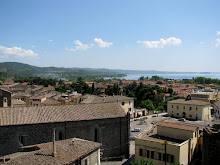
Elena Lietta gave the class a psychoanalytical analysis of women, food and globalization. An expert on eating disorders, Lietta is knowledgeable about psychoanalytical analysis of people’s (and women's) reactions to a changing world.
Anorexia/bulimia.
Women are sensitive to changes in the planet.
Food/children/globalization and the relation between them.
Women power + creativity, women and the enviroment.
Women in peace.
A psychoanalytical approach to life.

Talking about women and food is like putting together two different galaxies.
Woman’s bodies are often equated with food. A female body often literally equates to food.

Willendorf Venus, an "archetypal" woman's figure.
An archetype is the type of the archaic, or the beginning. Humanity's fondness for round shapes may derive from a natural fondness for the shape of a woman's breast We have very few other instinctual perceptive patterns.
Woman and weakness:
Woman transmits habits and traditions about food and eating. Or she used to be the transmitter, anyway, as the modern family is changing its habits.
Points:
Woman as producers of food. Activities like cooking, baking, and finding roots.
Woman’s body as food.
Woman as guider, protector, and conservator. A maternalist.
Women as witness.
Women as creators of their own images.
Women active today on cultural and political levels.
Women who understand the depth of their responsibility as world and human citizens.
Women often observe and grab things from past. They will use old techniques and patterns. All knowledge about food and survival ties into the domestic economy.
Home economics involves certain skills, such as how to cook, how to preserve food, and so forth. This was the old time knowledge of women. Women today are now trying to recover the lost abilities and capacities, that their own grandmothers did not transmit to them.
Many female environmentalists:
This is how gender roles come up. When you speak of knowledge and mental models, the idea of gender and roles is more evident
Women in images
Most famous images were produced by the mind of a man OF a woman.
How are women mirrored in the minds of a male-produced image?
The majority of images we have are not produced by women.
Gender roles have become complicated!
Why are women still trying so hard to look beautiful? For who, for what? Who is ruling the game and controlling the situation? Many women could realize that they are not really free, and then might stop doing a lot of the things they do against their own bodies.

Many consumerist, dependent habits that we use to feel better might also be eliminated. Who is really keeping the system going? Most of the consumer market, in many areas, is aiming at women. If there is no awareness of this point, we are in trouble.
Women often adapt themselves without discussing it.

Work by Elisabetta Sirani, female painter of the 16th century.
Women can be the creators of their own images. Female painters in 16th century did exist, in small numbers.
We need a more critical approach to women’s representations of their selves.
Women are often active on a cultural and political level, and are acutely aware of changing life systems. Women begin from a difficult situation today: being completely absorbed into something that goes against natural human inclination. Modern humans are gaining year after year of life, but they are not reaching a place where they can say, “I feel responsible about my body, about what my family eats, the air quality, what we wear.”
Nothing helps us reach this goal of deeper integration with the earth beyond strong effort. We see the opposite tendency and way of life dominant in society. More and more big outlets are appearing in Italy, outlets that pour out clothes and goods. Even people who live in small places like Bolsena will go on Saturday afternoon to the supermarket to buy artificial things. They don’t walk, and they don’t use the environment they have around. They are actually renouncing something old by buying new things.
Women in families (or acting alone) could really change this sad situation if they were aware.
Localism: what does that mean?
Do I have to go away and buy things from a different country? Should I simply move around and go about my life without a sense of real object or significance? Should I see what I have close to me, and take care of what is close? This not only an ecological or political or territorial view . The notion of a localist who "only eats food from their own area" is a reductive interpretation of the concept. Localism does mean things like saving energy on transportation, and looking closer to home for the majority of our resources.
Localism doesn’t mean the rejection of what comes from other countries.
Women are local by nature.
Women take care of what is around them. If you put together in transversal form some female characteristics, we see that women are ideally suited for local change. If you take care of maintenance of a place and a family, you are de-facto local, no matter where you began. We are hoping to see a daifferent quality of relationships with people, a resurgence of the idea of community.
A community has to be small, 150 or so people – the human mind cannot really do it with more then that. We can’t have significant relationships with more then about 200 people. A relationship is not a contact. Knowledge is not information. The Internet can't fill these gaps.
If you take care of things, you recognize it quickly when you don’t have enough. You realize there is no more pasta left if you have to cook, so you become concerned. You try to figure out how to go on, and keep in mind quantities. If you are not following this process, all of a sudden, you’ll be out of something and will have no back-up plan.
The conscious, responsible use of common goods of the world is still in the hands of women. Unfortunately, most women in power don’t have enough time to do this. We are watching incredible paradoxical imbalances. Many women still do local work but are not recognized. The industrial economy is still destroying local resources.
Each person needs to do what they can where they are.

At this level we have many women committed to environmental protection. We have women trying to save tree, whales, whatever.
Women are often involved in the peace movement, and the protection of peace. They are working for nonviolence and peace, which is a form of protection of food, the earth, and human life. Wars are among the worst agents of destruction of resources. Wars also produce many opportunities to build and create new businesses.
Modern, contemporary women have a different way of thinking, planning, organizing, of setting up their house and their computer. Modern women have different style in general of relating to the world. Women have, in the 50 years or so since WWII, been displaced.
I am not saying women should stay home and rear children. They can do what they want, but they should do it in their own way. The title of my book is in fact My Own Way. Women’s preferred way of doing things is generally ignored.
Men have much more convoluted minds. The use of technology is big for them. Women maybe use it less. Men so conditioned that if they must do a simple object, they go for a tool, they don’t think they can do it with their hands. Even if it is a very simple task.
I’ve eliminated many tools in my kitchen since there is no room left for new things. Everything must be done with something else. In a house, tools are usually hung above a woman’s height if the husband is taller. A strong visible problem must exist to receive the attention of difference. If you are apparently normal, you are not different.
Many differences have been completely erased between men and women. We see much misunderstanding in communication/relationships and love. We are speaking the same and are from the same country, and village. Why all this misunderstanding? The differences between men and women today still not resolved.
Going one week without buying something is very difficult. You realize how often you feel like spending money in a shop, and how often you don’t need what you are buying.
An anorexic, for her part, is saying “I want something else, your food is not nourishing me, I refuse.” A form of protest, a meaning.
Certain kinds of women and certain kinds of men want to change.